









CHAPTER ONE
The Book, the Bay, the Bet
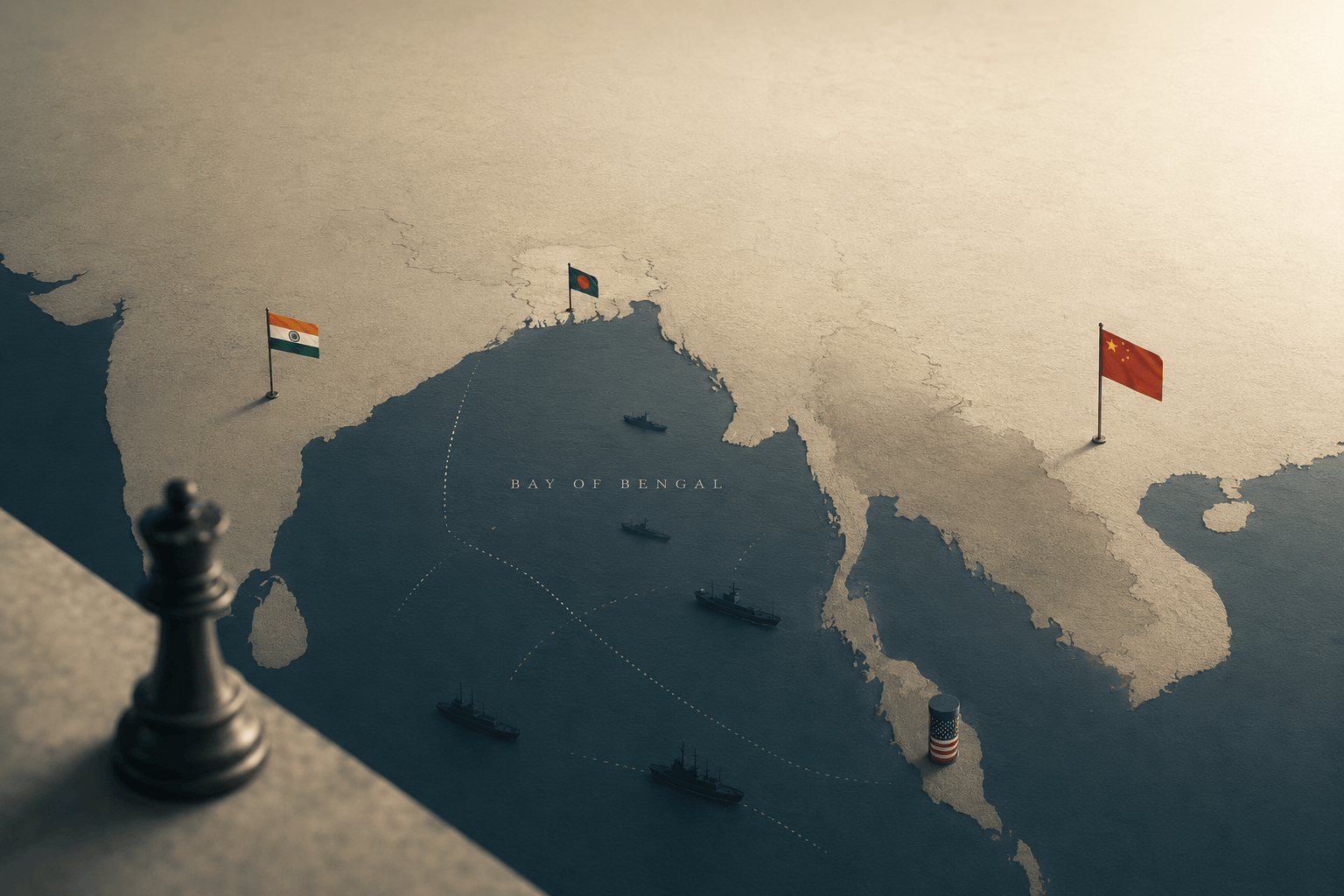
In Monsoon, Robert Kaplan made an argument that has aged into prophecy: that the Indian Ocean, not the Pacific or the Atlantic, would become the century's central stage, because it is where energy, trade and rival navies would collide with the least room to manoeuvre. Kaplan wrote of the Bay of Bengal as the ocean's most contested northern lip — the place where China's hunger for a route around the Malacca Strait would eventually run headlong into India's oldest anxieties about its own eastern flank. I have returned to that argument more than once while reporting this dossier, because nothing happening in Rakhine State or in the boardrooms of Beijing and Dhaka makes sense without it.
Kyaukpyu is a town of perhaps 30,000 people on Myanmar's Rakhine coast that most Bangladeshis have never heard of. It should not stay that way. What is being negotiated there, and now extended toward Chattogram and Mongla, is not a shipping contract. It is a bid to redraw who controls the flow of goods, energy and influence across the entire eastern rim of South Asia — with Bangladesh, for the first time since independence, holding a hand worth playing.
CHAPTER TWO
A Corridor Born Comatose
The idea is older than most of the officials now negotiating it. In August 1999, academics from Bangladesh, China, India and Myanmar formalised something called the Kunming Initiative — a talking shop, not a treaty, bringing together think tanks with no government money behind them. It stayed that way for over a decade. The turn came in 2012, when then-Chinese Premier Wen Jiabao raised the idea directly with India's Manmohan Singh, and in May 2013, Wen's successor Li Keqiang formally proposed a Bangladesh-China-India-Myanmar Economic Corridor during an official visit to Delhi. Within weeks, Bangladesh's own army chief publicly called it a threat to sovereignty, and the politician who would later become prime minister argued no decision of that scale should bypass Parliament. The corridor was contested in Dhaka before Beijing had even drawn a map.
A 2014 working session in Cox's Bazar and an April 2017 meeting that produced a wish-list of eleven cooperation sectors were as far as it got. Nothing came out of a 2018 meeting in Myanmar. A 2019 attempt to revive momentum in Kunming generated headlines and little else. The reason was not technical; it was India and China's mutual refusal to let the other treat the corridor as a Track I strategic asset. New Delhi wanted subregional development studies. Beijing wanted inter-governmental commitment. Neither blinked, and BCIM drifted into the file marked "comatose" that regional analysts still use today.
China did not wait for consensus. It simply built its own bilateral version through Myanmar, folding it into the Belt and Road Initiative as the China-Myanmar Economic Corridor — a roughly 1,700-kilometre spine running from Kunming in Yunnan Province to the Bay of Bengal coast at Kyaukpyu. That corridor never depended on Delhi's approval. It is why Kyaukpyu, not Kolkata, became the project's true anchor.
CHAPTER THREE
Kyaukpyu: The Port China Cannot Quite Build
Negotiations over Kyaukpyu predate the Belt and Road Initiative itself. CITIC Group signed initial memoranda in 2009, and Myanmar formally awarded the deep-sea port project to a CITIC-led consortium in December 2015 under a 50-year lease, at an original valuation of $7.3 billion for the port and a further $2.7 billion for an adjoining special economic zone. The scale frightened Myanmar's own civilian government. In 2018, under Aung San Suu Kyi's National League for Democracy administration, the first phase was slashed to $1.3 billion specifically to avoid the kind of debt dependence that had swallowed Sri Lanka's Hambantota port. CITIC's ownership stake was trimmed from an initial 85 percent to 70 percent, with Myanmar's state-backed SEZ authority holding the remainder.
Xi Jinping's January 2020 visit to Naypyidaw finalised the port joint-venture framework. The 2021 military coup changed the political arithmetic without killing the project; if anything, a junta desperate for legitimacy and hard currency became a more pliant partner than an elected government ever was. In December 2023, the junta and CITIC signed a supplementary agreement to accelerate construction — an agreement that came bundled with enhanced security guarantees for Chinese personnel, a tell of what was already unfolding on the ground.
<img src ='https://cms.thepapyrus.com.bd/public/storage/inside-article-image/sfasth1ej.png'>
What Kyaukpyu offers China is not commercial convenience — it is strategic insurance. Roughly four-fifths of China's seaborne energy imports currently pass through the Strait of Malacca, a chokepoint the United States Navy could, in theory, close. An oil pipeline and a parallel gas pipeline already run from Kyaukpyu to Kunming, built between 2010 and 2015 despite fierce local opposition. A deep-sea port at the same terminus would let Middle Eastern and African cargo reach Yunnan overland, bypassing Malacca and the South China Sea entirely. That is the prize China has spent seventeen years and multiple renegotiations refusing to walk away from.
CHAPTER FOUR
Rakhine's War and the Vanishing State
The project's greatest obstacle is no longer financing. It is geography of a different kind — the disappearance of Myanmar's own writ over the land the corridor needs to cross. The Arakan Army, an ethnic armed organisation fighting for Rakhine autonomy, now controls approximately fourteen of the state's seventeen townships. The junta formally retains only three: Kyaukpyu itself, the state capital Sittwe, and the island township of Manaung. Even that claim is generous. Arakan Army units have reportedly operated within two kilometres of the junta's Danyawaddy naval base, and fighting has repeatedly reached the outskirts of the port site itself.
The human cost of that instability has already landed on Chinese balance sheets. A $140 million power plant at Kyaukpyu, built through a joint venture between Hong Kong-listed VPower Group and China's state-owned CNTIC, was suspended in late 2023 after the junta failed to supply enough gas and could not pay in US dollars. It was then progressively dismantled and relocated starting in late 2024, with the pace of removal accelerating sharply through early 2026 as fighting drew closer. Beijing's response was not retreat but escalation of control: in February 2025 the junta enacted a Private Security Services Law explicitly permitting Chinese security firms to deploy personnel inside Myanmar to protect Belt and Road assets, and residents in Kyaukpyu report Chinese security personnel already present on the ground.
"A port intended for commercial use that gradually acquires the characteristics of a strategic logistics hub is precisely the pattern security analysts have already tracked at Gwadar, Djibouti and Hambantota."
June 2026 brought the clearest signal yet of where Beijing's priorities sit. Min Aung Hlaing made his first state visit to China as junta leader from 15 to 19 June, received with a 21-gun salute and honours usually reserved for recognised heads of state. The two sides signed eighteen memoranda covering security, development, trade and infrastructure, and Xi Jinping personally pressed the junta chief to accelerate both the Kyaukpyu port and the long-delayed Muse-Mandalay railway. Min Aung Hlaing, in turn, pledged to protect Chinese enterprises and finalise the broader BRI cooperation plan. China had already begun binding Myanmar to these commitments months earlier, establishing a BRI Leading Committee for Implementation under the junta leader's own chairmanship in August 2025 — an institutional mechanism designed to survive any future government in Naypyidaw.
CHAPTER FIVE
Beijing's Pivot: Tarique Rahman in the Great Hall
Five days after Min Aung Hlaing left Beijing, Bangladesh's Prime Minister Tarique Rahman arrived. His four-day visit, from 22 to 26 June 2026, was his first foreign trip since taking office in February following the BNP's return to power, and China — not Malaysia, which he had visited days earlier — was unmistakably the trip's centre of gravity. He met Xi Jinping and Premier Li Qiang at the Great Hall of the People, was received with a red-carpet ceremony and a guard of honour, and left having elevated bilateral ties to what both governments now call a "China-Bangladesh community with a shared future in the new era" — only the second such designation China has extended in South Asia, after Pakistan.
The visit produced fifteen memoranda of understanding, two formal agreements and a sixteen-point joint communiqué, spanning river management, flood mitigation, green and digital economy cooperation, and — critically — a proposal Beijing had been quietly rebuilding for years: the China-Myanmar-Bangladesh Economic Corridor, extending the existing CMEC spine from Kyaukpyu onward to the Bangladeshi ports of Chattogram and Mongla. China separately expressed interest in modernising both ports directly, developing Chattogram into a regional commercial hub and upgrading Mongla's handling capacity. Xi also offered Chinese feasibility studies and technical support for restoring the Teesta River basin, a project Dhaka has sought for over a decade against unresolved objections from India's West Bengal government — Beijing's foreign ministry took care to describe this cooperation as directed at no third party.
Bangladesh's own posture toward the corridor proposal has been calculated rather than eager. Foreign Minister Khalilur Rahman told reporters on 27 June that Dhaka was "currently examining" the plan and had "taken no position," adding that any overland connectivity through Myanmar would remain conditional on peace returning to Rakhine State. That caution is instructive: it tells you Dhaka understands exactly what it is being offered, and exactly how much leverage it retains by not saying yes immediately.
CHAPTER SIX
The Arithmetic Dhaka Cannot Ignore
Strip away the ceremony, and the case for Bangladesh's interest rests on numbers that predate the corridor talk by years. China is already Bangladesh's largest single source of imports, supplying roughly a quarter to a third of everything Bangladesh buys from abroad — machinery, electronics, industrial inputs, construction materials. Chinese exports to Bangladesh reached nearly $23 billion in 2024. Bangladesh's exports back to China, by contrast, remain a rounding error by comparison — tens of millions of dollars a month, dwarfed by garment shipments headed to the United States and Europe. This is not a trading relationship; it is a supply dependency, and it has produced a structural imbalance Dhaka has had little leverage to correct.
<img src ='https://cms.thepapyrus.com.bd/public/storage/inside-article-image/703ivuejn.png'>
That imbalance is about to matter more, not less. Bangladesh is scheduled to graduate from Least Developed Country status, which will steadily erode the preferential, duty-free access to European and other markets that its garment sector has relied on for three decades. Every serious economic planning document produced in Dhaka over the past two years has said the same thing in different words: Bangladesh must diversify what it exports and to whom, deepen its manufacturing base beyond ready-made garments, and attract the kind of foreign direct investment that builds factories rather than just ships containers. A corridor that plugs Chattogram and Mongla directly into Yunnan's industrial supply chains, if it is ever built, would answer exactly that need — turning Bangladesh from a consumer of Chinese goods into a transit and light-manufacturing node between China's south-west and the Bay of Bengal.
The government's own signalling suggests it understands the stakes. During the Beijing visit, Bangladeshi officials announced a 180-day action plan to fast-track investment approvals, new economic zones at Anwara and Mongla, Bangladesh's first dedicated investment promotion office inside China, and a pledge to issue new investment licences within fifteen days. More than eighty Chinese corporate executives attended a parallel investment forum in Beijing during the same visit. None of that requires the corridor to be built. All of it becomes more valuable if it is.
CHAPTER SEVEN
New Delhi's Nightmare: The Chicken's Neck Squeeze
India's Ministry of External Affairs response to the corridor proposal has been carefully worded — "watching closely," neither endorsing nor condemning. The calculation behind that caution is not subtle. The Siliguri Corridor, barely twenty-two kilometres wide at its narrowest, is India's only land connection between its mainland and eight north-eastern states. A Chinese-financed transport network running through Myanmar to Bangladesh's south would sit just below that chokepoint; Chinese-linked infrastructure ambitions in Nepal already press on it from the north-west. Indian strategists describe the resulting geometry bluntly: an infrastructure pincer that requires no soldier to move and no shot to be fired to alter the regional balance of power.
India is not without its own answer, and has not been for eighteen years — it simply has not built it fast enough. The Kaladan Multi-Modal Transit Transport Project, a $484 million initiative conceived in 2008 to link Kolkata to Mizoram via Myanmar's Sittwe port, remains incomplete in 2026. The India-Myanmar-Thailand Trilateral Highway has been in planning for over two decades. Against a Chinese corridor that moved from proposal to eighteen signed memoranda in a single week of diplomacy, India's connectivity architecture in its own north-east looks, to put it plainly, outpaced by its rival's willingness to work with an internationally sanctioned junta that Delhi's democratic sensibilities make harder to fully embrace.
This is the leverage Bangladesh now holds, whether or not it intends to use it fully: a genuine choice between two large neighbours competing for its port capacity, its river management cooperation, and its position on their shared eastern frontier. Dhaka has already signalled it intends to keep both doors open — expanding cooperation with China while explicitly declining to frame the relationship as exclusive, and continuing separate connectivity and trade engagement with India, Nepal and Bhutan. A small country rarely gets to make two great powers compete for its goodwill. Bangladesh, for the moment, is one of the few that can.
================================================================
THE PAPYRUS VERDICT
A Bet Worth Placing, Not Yet Worth Banking
================================================================
I will say plainly what the diplomatic language never will: the China-Myanmar-Bangladesh Economic Corridor, as a physical route from Kunming through Kyaukpyu to Chattogram, is not getting built in this decade. Myanmar does not currently exist as a state capable of guaranteeing safe passage across Rakhine. The Arakan Army holds fourteen of seventeen townships, the Muse-Mandalay railway has moved at a crawl since its 2021 feasibility MoU, and even the most optimistic engineering timeline — a ceasefire tomorrow, financing secured, construction uninterrupted — puts the railway alone close to a decade from completion. Any editor who tells Bangladeshi readers to expect Chinese cargo rolling into Chattogram by rail within five years is selling fiction.
But that is the wrong economic question to ask, and it is where most coverage of this story stops short. The corridor's PHYSICAL COMPLETION and its ECONOMIC VALUE TO BANGLADESH are two different clocks, running at two different speeds. The second clock started ticking the moment Tarique Rahman walked into the Great Hall of the People, and it is already paying out.
"Bangladesh does not need the railway to arrive. It needs the
two great powers competing for its ports to keep competing —
and every month that competition continues is a month Dhaka
can convert into capital, credit and concessions."
Here is the case for optimism, built on what is already committed rather than what remains hypothetical. The direct bilateral packages attached to the corridor conversation — Chattogram and Mongla port modernisation, the Anwara and Mongla economic zones, Teesta River basin restoration, a 180-day investment fast-track, Bangladesh's first investment office inside China — do not require a single kilometre of Myanmar track to be laid. They are deliverable now, and Beijing has every incentive to deliver them regardless of Rakhine's war, because a modernised Chattogram serves Chinese maritime trade whether or not the overland spur ever reaches it. If even half of the fifteen MoUs signed in June 2026 convert into disbursed financing over the next three years, Bangladesh gains port capacity and industrial-zone infrastructure it could not otherwise afford as it heads into a post-LDC world with thinner trade preferences and a garment sector under margin pressure.
The second and, I would argue, more valuable gain is not economic in the narrow sense at all — it is negotiating leverage. For the first time since 1971, Bangladesh sits at the centre of two competing infrastructure visions rather than the periphery of one. India's Kaladan project, stalled since 2008, will now move faster or lose relevance entirely; either outcome benefits Dhaka. New Delhi's own anxiety about the Siliguri Corridor gives Bangladesh a stronger hand in its bilateral India file too — water-sharing, transit rights, border trade — precisely because India can no longer afford to take Bangladesh's alignment for granted. A small state's best economic strategy, when it cannot outspend its neighbours, is to make itself indispensable to both. Dhaka's calibrated "examining, no position" posture on the corridor is not indecision; it is the correct opening move in exactly that game, and Foreign Minister Khalilur Rahman's insistence on Rakhine stability as a precondition keeps Bangladesh's hands clean of a Myanmar war it did not start and cannot control.
The risk sits on the other side of the ledger, and I will not soften it: Bangladesh's trade deficit with China, already near $22 billion in Chinese exports against a fraction of that flowing back, does not correct itself through MoUs. It corrects through Bangladeshi manufacturing capacity Beijing has promised to help build but has, in prior BRI relationships from Sri Lanka to Pakistan, been slow to actually transfer. Debt financing tied to port modernisation must be structured on Bangladesh's terms, not CITIC's Kyaukpyu terms, where Myanmar's own government once had to renegotiate a 70 percent stake down from 85 just to protect its sovereignty over the project. Dhaka's negotiators have that precedent sitting on the table in front of them; they have no excuse to repeat it.

Comments