






Of all the ideas Richard Werner challenges, this is the one I found hardest to accept, simply because it is repeated so constantly, by so many credible people, that it stopped feeling like a theory at all. Every time a central bank meets, every financial news segment, every economics class I ever sat through treated one thing as settled: lower interest rates stimulate economic growth, and higher interest rates slow it down. It is presented less as a hypothesis and more as a law of nature. Werner's argument, built on the same instinct for empirical testing that drove his work on bank credit creation, is that the arrow of cause and effect here has been pointing the wrong way the entire time.
The Textbook Model: Prices, Equilibrium, and the "Cost of Money"
Standard economics teaches that markets work through equilibrium. Prices rise and fall until the quantity people want to buy exactly matches the quantity people want to sell. Applied to the economy as a whole, interest rates are described as "the price of money." When a central bank lowers rates, borrowing becomes cheaper, businesses and households borrow more, spending rises, and growth follows. Raise rates, and the reverse happens. This single mechanism is treated as the primary lever policymakers have to manage an entire economy.
Werner rejects the underlying assumption first: he argues there is no real evidence that markets actually reach this kind of equilibrium at all. Instead, he describes markets as rationed, governed by what he calls the short-side principle whichever quantity is smaller, the amount people are willing to supply or the amount people are willing to demand, is what actually determines the outcome, regardless of what price theory says "should" balance the market. If a bank is only willing to lend a certain amount of new credit, that ceiling not the interest rate on paper determines how much borrowing actually happens.
Testing the Causal Arrow
Working with a statistician, Werner ran formal causality tests using a statistical method called Granger causality, which checks whether past values of one variable help predict future values of another on the relationship between interest rates and economic growth. Two things stood out in the results.
First, the correlation between interest rates and growth turned out to be positive, not negative. Periods of high growth tend to come with high interest rates; periods of low growth come with low interest rates and the opposite pairing from what the textbook predicts.
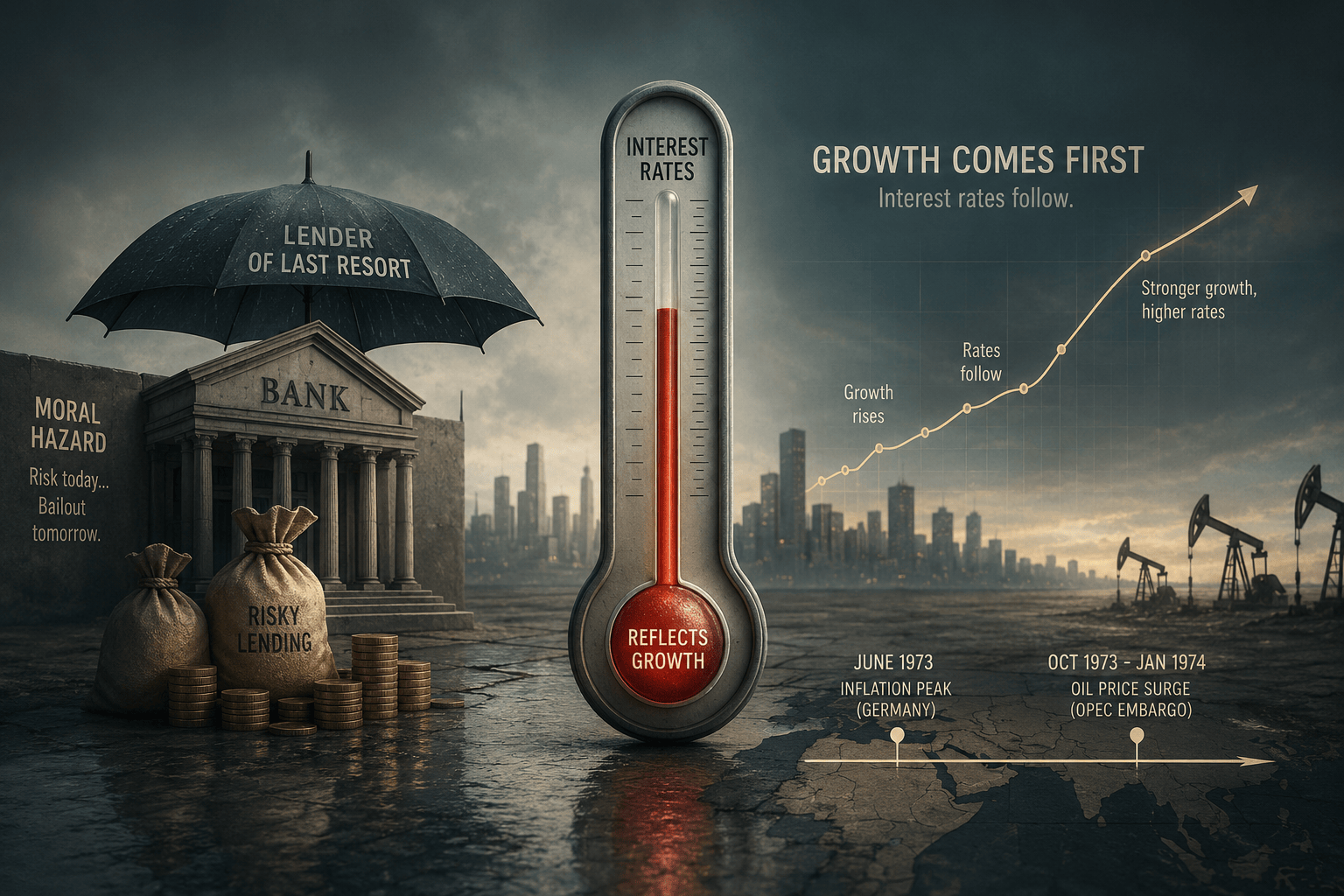
Second, and more importantly, the direction of causation ran from growth to interest rates, not from interest rates to growth. In plain language: strong economic growth tends to cause higher interest rates afterward, not the other way around. Werner extends this to long-term government bond yields as well, showing that 10-year bond yields tend to track nominal GDP growth rather than lead it moving in step with the economy rather than steering it.
Why the Arrow Actually Makes Sense Once You Flip It
At first this seems backwards, but it lines up with something else Werner argues in the second article: interest rates, in his account, were historically set by lenders to gauge a borrower's ability to repay and GDP growth is essentially a measure of how much income is available to service and repay debt. If national income is growing quickly, lenders can reasonably charge more, because borrowers can afford to pay more and the risk of default is lower. If growth is weak, lenders have to charge less, because a high rate on top of weak income growth would make debts spiral rather than get repaid. Seen this way, the interest rate is less a steering wheel for the economy and more a thermometer reading — a number that reflects the temperature of underlying growth rather than a dial that sets it.
<img src ='https://cms.thepapyrus.com.bd/public/storage/inside-article-image/ka010ljap.png'>
A Real-World Test Case: The 1970s Inflation That Wasn't About Oil
Werner uses a timing discrepancy to make his point concrete. The standard story of 1970s inflation blames the OPEC oil embargo: oil prices roughly quadrupled between October 1973 and January 1974, and this shock is credited with driving the decade's inflation. But Werner points out a basic sequencing problem: in Germany, inflation had already peaked in June 1973 a full seven months before the oil price spike even began. An effect cannot precede its cause. His alternative explanation returns to the theme of the first two articles: bank credit creation had been expanding rapidly across the US, Germany, and Japan from 1971 onward, following the breakdown of the Bretton Woods gold-exchange system, and it was this credit expansion not the oil shock that was already driving prices upward before OPEC's embargo even began.
He makes a parallel claim about the inflation of 2021–2022, saying that by tracking Federal Reserve credit creation data available as early as 2020, he warned publicly, well before Russia's invasion of Ukraine, that significant inflation was roughly 18 months away attributing the coming inflation to a surge in bank lending for consumption (as opposed to productive business investment), not to war-driven energy prices or supply-chain disruption.
Where Moral Hazard Fits In
This section connects to one more accounting-flavored idea worth naming clearly: moral hazard. In banking, moral hazard describes what happens when an institution is shielded from the consequences of its own risk-taking typically because it expects to be bailed out and therefore has a weaker incentive to behave cautiously. Werner raises this in the context of central banks acting as lender of last resort: the original justification for creating institutions like the Federal Reserve was that even a well-run bank can collapse if a rumor triggers a sudden run on deposits, and a central bank able to supply emergency liquidity can prevent that kind of panic from destroying a fundamentally sound institution. But he argues the same tool, applied carelessly, teaches banks that reckless lending will eventually be absorbed by the public rather than the people who made the decisions which is precisely the danger the next article picks up, when we look at how a central bank actually cleans up a banking crisis after the risk-taking has already happened.

Comments