




In June 1941: Hitler and Stalin, the historian John Lukacs spends three hundred pages on a single, devastating question: why did a man as paranoid and well-informed as Stalin refuse to believe, until German tanks were already inside Soviet territory, that Hitler intended to invade? Lukacs's answer is not that Stalin lacked intelligence. He had it, in abundance, from Sorge in Tokyo to defectors crossing the frontier in the final week of May. His answer is that Stalin had convinced himself a piece of paper — the Molotov-Ribbentrop Pact — was a strategic reality rather than a tactical pause, because believing otherwise was unbearable. He mistook the absence of war for the presence of peace.
I want to suggest, in this piece, that two leaders are making the same wager today, in two different theaters, and that both wagers end badly. Donald Trump believes a fourteen-point memorandum signed in Versailles last Wednesday has bought him an Iran he can manage through diplomacy rather than invasion. Vladimir Putin believes a war he has spent four years insisting is going according to plan can absorb Ukraine's deepening strikes into Russia proper without forcing him into the wider, costlier war he has tried to avoid. Both men are reading a ceasefire as a settlement. Both are wrong, for the same reason Stalin was wrong: the document was never meant to hold. It was meant to buy the weaker side time, and the stronger side cover.
I. The fourteen points were dead before the ink dried
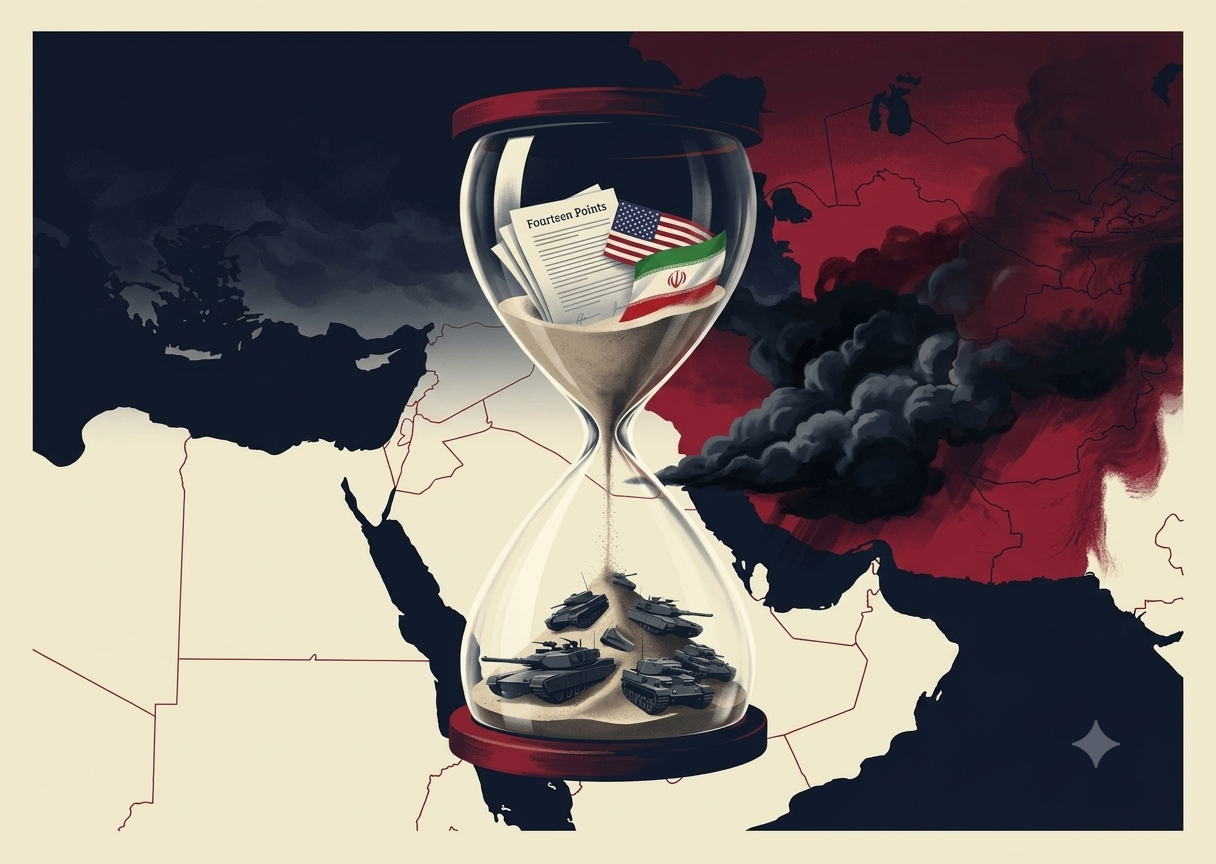
The memorandum of understanding Trump signed with Iranian President Masoud Pezeshkian calls, in its first article, for the immediate and permanent end of hostilities on every front the war has touched — including Lebanon. It hands administration of the Strait of Hormuz to Iran's own Persian Gulf Waterway Authority. It opens a sixty-day window to negotiate sanctions relief, the unfreezing of Iranian assets, and a $300 billion American-backed reconstruction package, with the IAEA brought in to verify the downblending of enriched uranium. Even Iran's new Supreme Leader, Mojtaba Khamenei — who inherited the post in March after an American strike killed his father — authorized the deal only while publicly complaining that Trump had bullied Iran into it out of desperation.
That complaint did not stop Israel. Within forty-eight hours of the signing, Israeli strikes on southern Lebanon had killed at least 32 people in the village of Qennarit, with separate strikes near Nabatieh killing sixteen more and Hezbollah answering with over fifty projectiles at Israeli positions. Talks meant to cement the MOU have now been moved to Burgenstock, Switzerland, with Pakistani and Qatari mediators scrambling to keep Tehran at the table. This is not a new pattern. It is the same pattern Lebanon has lived through twice in two years: a ceasefire announced, and Israel treating the document as a formality rather than a constraint, just as it did within hours of the April 8th truce, when it launched what it called its most powerful strikes of the war and killed over 350 people in a single day. Netanyahu's position has not changed since: the ceasefire with Iran does not bind Israel's war with Hezbollah, whatever Article 1 says.
This is the structural flaw the fourteen points cannot survive. Washington can sign whatever it wants with Tehran; it cannot deliver Jerusalem's compliance, and everyone at the table knows it. What the MOU actually accomplishes is to relieve Trump of an unsustainable position — a naval blockade straining American fuel reserves, a Pentagon warning him off any attempt to seize Kharg Island, farmers short on fertilizer, and a midterm electorate that did not sign up for a Gulf war — without requiring him to admit defeat. It is not peace. It is an exit ramp dressed as a settlement, and exit ramps have a way of leading back onto the highway.
Here is my forecast, stated without the hedge financial analysts like to hide behind. The sixty-day window closes without a durable Lebanon settlement, because Israel has no incentive to give Hezbollah the recovery period a real ceasefire would provide. Iran, watching its proxy bled out while reformists around Pezeshkian argue this is the price of finally re-entering the global economy, will not re-arm Hezbollah fast enough to matter. By the time American voters have finished punishing Republicans at the midterm box in November for an inflation crisis this war helped cause, Washington will have run out of diplomatic cover and patience simultaneously. Expect the invasion option to return to the table in early 2027, once midterm politics have been absorbed and the brutal Gulf summer has passed — the same seasonal logic that shaped this year's campaign. The target will not be regime survival talks. It will be the assets the MOU left untouched: the enrichment infrastructure the IAEA inspectors are nominally monitoring, and whatever remains of Iran's missile production base. Unconditional surrender was never withdrawn as a war aim. It was only postponed.
II. Moscow's refinery and Stalin's mistake
While Tehran and Washington were finalizing their fourteen points, Ukraine was rewriting the rules of its own war. On the nights of June 16th and 18th, Ukrainian drones struck the Moscow Oil Refinery in the Kapotnya district — a Gazprom Neft facility barely fifteen kilometers from the Kremlin — in what Russian officials themselves are calling the most intense assault on the capital since the invasion began. Hundreds of drones were intercepted on the second night alone; flights were suspended, roads closed, and at least sixteen people injured by falling debris. Zelensky took the footage to NATO leaders in Brussels that same week with a simple message: the war is not stalemated, it is escalating, and it is escalating toward Russia's own population centers.
This is where Lukacs's book becomes more than a literary device. Putin's entire public posture since 2022 has rested on a version of Stalin's 1941 confidence: that Russia's adversaries lack the will, the unity, or the industrial capacity to strike the homeland in a way that forces a real reckoning. Drone war was supposed to be something Russia did to Ukraine, not the reverse. Every previous Moscow strike — the 2023 Moscow City hits, the November 2024 wave — was small enough to be absorbed as a propaganda inconvenience rather than a strategic fact. The Kapotnya strikes are different in scale, repetition, and target selection. They hit fuel infrastructure that supplies the capital region, not symbolic towers. They came twice in three days. And they came while the Kremlin was watching the Iran file closely, calculating that American and European attention was consumed elsewhere.
Stalin's error was not failing to see the German buildup. It was assuming Hitler needed him to believe in the pact for the pact to hold, when in fact Hitler had already decided the pact was a tool for sequencing, not peace. Putin's error, if this analysis holds, will be assuming Ukraine's deep strikes are a bargaining chip Kyiv will trade away for a ceasefire on Russia's terms, when in fact they may be the opening phase of a campaign designed to make the war intolerably expensive on Russian soil specifically because European and American patience for funding Ukraine's defense is thinning. A Kremlin that reads escalation as desperation, rather than as a deliberate shift in Ukrainian and NATO strategy, is reading the situation exactly as Stalin read the spring of 1941 — and is liable to be just as unprepared for what a "bigger attack into the mainland of Russia," to use the framing this moment deserves, will demand in response. The risk is not that Russia loses the war it is fighting. The risk is that Russia escalates against what it perceives as an existential strike on the homeland, and that escalation does not stay confined to Ukrainian territory. A war fought for four years at arm's length from Europe's center does not have to stay there indefinitely.
III. Two wagers, one creditor
The Iran file and the Russia file are not separate stories. They are financed by the same actor, watched by the same actor, and constrained by the same actor: China. Beijing buys the overwhelming majority of Iran's oil and has, by most accounts, pushed Tehran toward the diplomatic off-ramp it eventually took. Beijing has also, for the most part, kept its banks within the lines of the sanctions regime on Russia, however close the two capitals stand rhetorically. China does not want a wider war in the Gulf, because it cannot afford one; it does not want a wider war in Europe, because instability there destabilizes the trade architecture China's export economy depends on. Both Washington and Moscow are, in their own ways, betting that Beijing's restraint will absorb the consequences of their own escalation. That bet may hold for 2026. It is not obviously durable into 2027, when an Iran invasion and a deepening drone war could be running concurrently, each one straining the very system of energy markets, shipping lanes, and dollar liquidity that Bangladesh — an economy that imports the overwhelming share of its fuel and leans on Gulf remittances for a meaningful share of its foreign exchange — has no margin to absorb twice over.
The Papyrus Verdict
The fourteen points are real, and they are not nothing — they have already pulled American forces back from the brink of a ground war this year. But a memorandum that Israel was never party to, and that Russia was never asked to sign, cannot bind the two actors most likely to make 2027 violent. Treat the Iran ceasefire as what the April truce and the November 2024 Lebanon ceasefire both turned out to be: a pause purchased by the side that could not yet afford to lose, not a peace agreed to by both sides that no longer wanted to fight. And treat Moscow's burning refinery not as a footnote to the Iran story but as the more dangerous headline — because a Kremlin that reads escalation as Stalin read 1941 is a Kremlin that may answer it the way regimes under existential pressure usually do: not proportionally, but with the bigger attack it was always capable of, the one it had simply chosen, until now, not to use.
Comments