




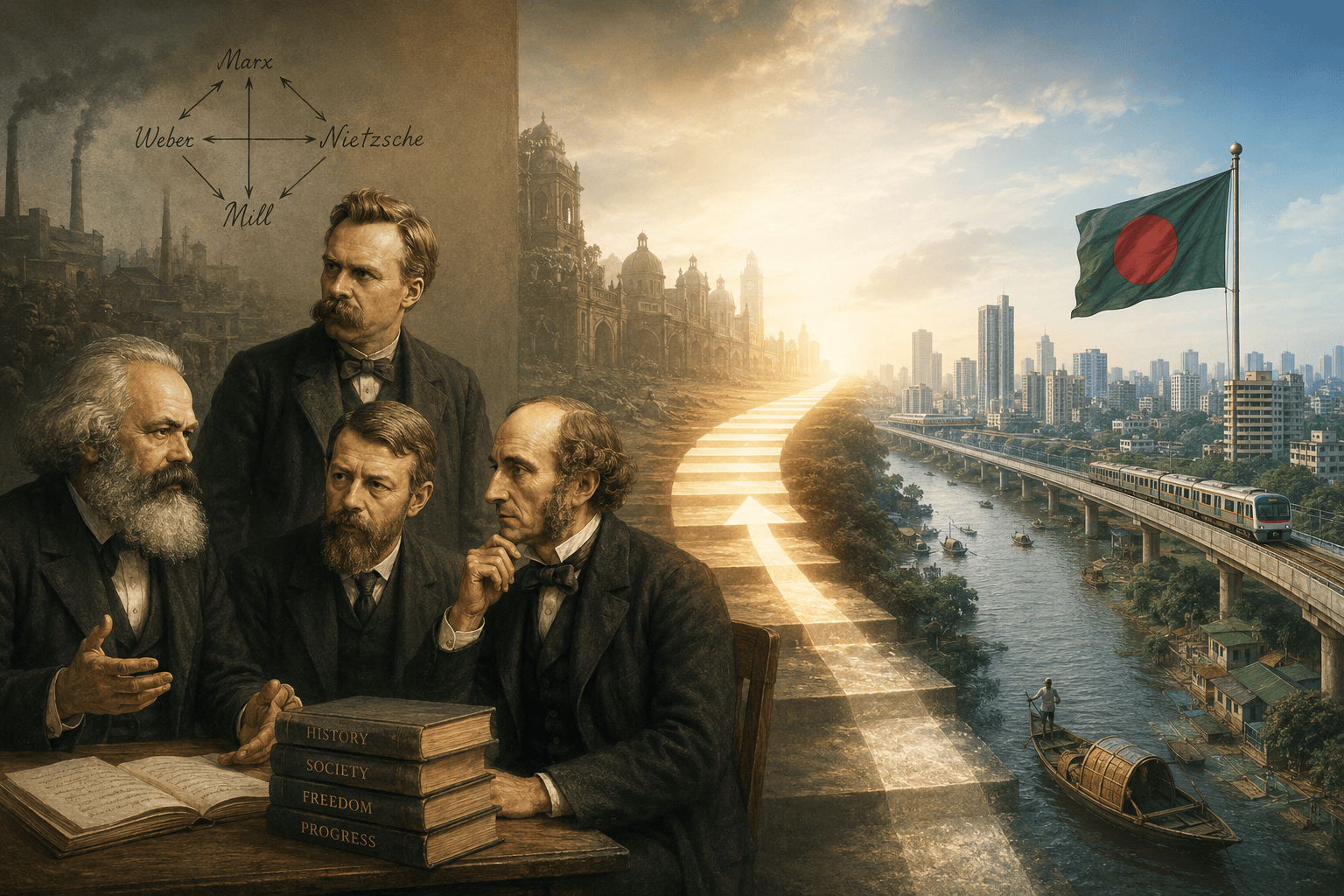




After Robert Nisbet, The Sociological Tradition
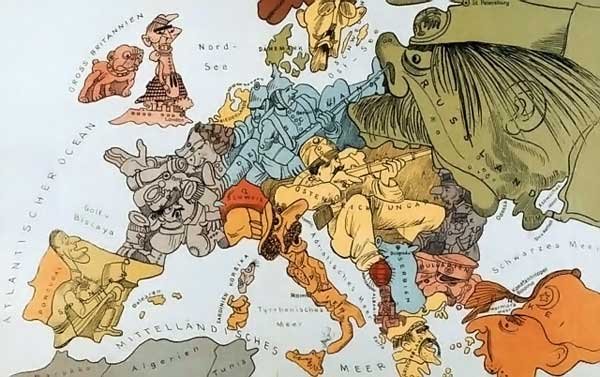
Nisbet once made the case that sociology itself was born out of the wreckage of the old European order — that its founding vocabulary of community, authority, and alienation only became necessary once the French and Industrial Revolutions had made the old certainties unusable. The four thinkers gathered here belong to that same wreckage. Each looked at a society coming apart and reassembling itself, and each reached a different conclusion about which lever actually did the work.
Every serious theory of history eventually has to answer one uncomfortable question: what, exactly, makes a society change? Not reform at the margins, not the ordinary churn of politics, but the deeper shift from agrarian to industrial, from feudal to capitalist, from mechanical solidarity to organic solidarity, from personal rule to bureaucratic administration. Four thinkers working across the nineteenth and early twentieth centuries each proposed an answer, and between them they built the vocabulary that sociology still uses to diagnose social change today.
None of the four agreed with each other, and that disagreement is the point. Thomas Robert Malthus located the prime mover in the arithmetic of population and food. Karl Marx located it in the ownership of production and the class conflict that ownership inevitably generates. Émile Durkheim located it in the division of labour and the moral regulation that either keeps pace with it or fails to. Max Weber located it in the long, quiet triumph of bureaucratic rationality over tradition and charisma alike. Read separately, each explains one corner of the modern world with real precision. Read together, they explain nearly all of it — including a case none of the four ever anticipated: a young, densely populated, post-colonial republic like Bangladesh, negotiating in a single generation what the West took two centuries to work through.
The Malthusian Floor
Malthus, writing at the close of the eighteenth century, offered the coldest and most mathematical of the four theories. Population, he argued, grows geometrically; the food supply grows only arithmetically. The gap between the two curves is not a policy failure to be legislated away rather it is a structural ceiling that every society eventually presses against. When a population outruns what its land and technology can feed, the correction arrives one way or another: through delayed marriage and demographic restraint if a society is fortunate, or through famine, disease, and war if it is not. For Malthus, sociocultural change begins beneath politics and ideology, in the plain arithmetic of mouths against harvests.
The clearest vindication of this logic is also its clearest refutation of Malthus's own pessimism: the demographic transition that swept Western Europe between roughly 1800 and 1950. Death rates fell first, as sanitation, medicine, and food distribution improved; birth rates fell a generation later, as urban wage labour made large families an economic liability rather than an asset. Societies that industrialized quickly enough climbed out of the Malthusian trap. Those that could not remained locked in the older equilibrium and it is exactly this equilibrium that a country like Bangladesh, among the most densely populated places on earth, has had to negotiate on a compressed timeline, its fertility rate falling from roughly six births per woman in the mid-1970s to near-replacement levels today largely through the same preventive checks Malthus described, joined by garment-sector wage labour and a remittance economy his own century could not have imagined.
Marx and the Machinery of Contradiction
Marx rejected the idea that population, or ideas, or culture drove history at all. For him the engine sat lower down, in the mode of production itself — the forces of production, meaning technology, labour, and resources, and the relations of production, meaning who owns what and who is compelled to sell their labour to whom. History for Marx moves through a sequence of these modes. Feudalism giving way to capitalism, capitalism eventually giving way to something beyond it and each mode carries within it the contradiction that will eventually break it apart. Historical materialism is simply the claim that the economic base determines the political and cultural superstructure, not the other way around: law, religion, ideology, and the state are downstream of who controls production, not the source of change themselves.
The case that has been read through Marxist categories more than any other in the twentieth century is Russia in 1917, even though Marx himself expected revolution to erupt first in the advanced industrial economies of Western Europe rather than in a largely agrarian empire. The contradictions that actually detonated were, nonetheless, classically material. A small but concentrated industrial working class in Petrograd and Moscow was labouring under brutal factory conditions; a vast peasantry was being crushed under land hunger and wartime grain requisitioning; and a Tsarist state built on landlordism and underdeveloped industrial capital could no longer manage the strain the First World War placed on it. The February uprising toppled the monarchy outright. What followed was the more consequential departure from Marx's own sequencing.
<img src ='https://cms.thepapyrus.com.bd/public/storage/inside-article-image/q3hx0k6ee.png'>
Lenin and the Bolsheviks argued that a disciplined vanguard party could compress the stages of history and seize the state on behalf of a proletariat that was, by orthodox Marxist accounting, not yet fully formed. The attempt to build a post-capitalist mode of production at the scale of an entire state succeeded in overturning the old ruling class and, within little more than a decade, generated a new bureaucratic stratum of its own, a development that Marx's framework alone struggles to explain, but which the fourth thinker in this accounts for rather precisely.
"The tools that dismantle one hierarchy are, more often than the revolutionaries expect, the same tools that build the next one."
Durkheim and the Fraying of the Common Bond
Durkheim looked past economics entirely and located the prime determinant in social structure — specifically, in the division of labour. As societies grow larger and more complex, he argued, they shift from mechanical solidarity, in which people are held together by shared belief and basic similarity, toward organic solidarity, in which they are held together instead by interdependence between highly specialized, dissimilar roles. This shift is not automatically stabilizing. When the division of labour races ahead of the moral regulation that is supposed to accompany it, the result is anomie: a condition of normlessness in which people lose clear guidance about obligation and limit, and social integration weakens even as material life improves.
Durkheim's own empirical proof of this came from his 1897 study of suicide rates across Europe, where he found elevated rates not simply among the poor or the isolated but among populations experiencing rapid change of any kind economic booms as much as economic crashes, Protestant communities as much as newly urbanized ones. His conclusion was structural rather than psychological: sudden change of either direction dissolves the regulative norms that once told people what to expect of life and what was owed to them, and it is this dissolution, not poverty as such, that produces anomic suicide as a genuinely social phenomenon.
The same mechanism appears today wherever rural migration outpaces the growth of new urban institutions which is a pattern visible in the strain on extended-family cohesion and the swelling of an under-employed youth cohort in a rapidly urbanizing city like Dhaka, even where traditional kinship and religious ties, stronger there than in most of the post-industrial West, continue to cushion the anomic effect that Durkheim warned would otherwise run unchecked.
Weber and the Iron Cage
Weber supplies the fourth and, in some respects, the most durable answer: rationalization. Modern history, in his account, is the long displacement of traditional authority, resting on custom, and charismatic authority, resting on the personal magnetism of a leader, by rational-legal authority, resting on impersonal rules applied consistently through office and procedure. Bureaucracy is simply the most technically efficient instrument yet devised for coordinating large-scale human activity, and once a state, an army, a firm, or a university reaches a certain scale, bureaucratic administration spreads almost regardless of the ideology nominally in charge of it. Weber's famous warning was that this efficiency comes at a cost: an "iron cage" of rules and procedures so impersonal that no single tyrant can be blamed or removed to escape it, because the domination belongs to the system rather than to any person within it.
This is precisely the thesis that completes the Russian case Marx's own framework left unresolved. A revolution built explicitly to abolish class domination produced, within a single generation, one of the most extensive bureaucratic apparatuses in modern history. The Communist Party's own administrative hierarchy not because the revolutionaries betrayed their ideals, but because large-scale planning and administration demand rational-legal hierarchy regardless of the ideology that commissions it. The same logic explains why liberal democracies, regulatory bodies, and multinational corporations operating under entirely different political systems still converge on remarkably similar organizational forms: standardized procedure, credentialism, and hierarchical accountability. Rationalization, for Weber, is civilization-agnostic. It is what scale itself demands, whether the state calls itself socialist, liberal, or something else entirely.
One Case, Four Lenses: Bangladesh Against the Liberal West
No single one of these four theories, applied on its own, adequately explains the distance between a country like Bangladesh and the mature liberal democracies of the West. Applied together, they show that the distance is less a matter of different destinations than of different positions along overlapping curves. Malthusian pressure, still visibly active in Bangladesh's land-to-population ratio, has largely inverted in the West into its opposite problem — below-replacement fertility and a contracting labour force managed through automation and immigration rather than expanded food production.
The Marxian contradiction that plays out in Bangladesh's garment-export economy, where ownership concentrates among a domestic industrialist class integrated into global capital chains while wage labour, disproportionately young and female, bears the sharpest costs naturally a tension made brutally visible by the Rana Plaza collapse of 2013 — has its own Western analogue in the tension between platform-economy precarity and concentrated capital at the very top, a tension similarly absorbed by electoral politics and welfare redistribution rather than resolved by revolutionary rupture in either case.
Durkheim's anomie appears on both sides of this comparison but in inverted form. Bangladesh's rapid rural-to-urban migration has outpaced the growth of new regulative institutions, producing classic anomic symptoms among an urbanizing youth cohort even as older mechanical solidarities — religion, extended kinship, village ties — remain unusually resilient by comparative standards. The West's organic solidarity is, by contrast, institutionally far more mature, built up through welfare states and professional associations that absorb much of the shock of specialization Durkheim worried about — yet anomie has reappeared there in a quieter register, in rising loneliness, so-called deaths of despair, and declining associational life even amid considerable material comfort, suggesting that a mature organic solidarity can decay just as a mechanical one can.
Weber's rationalization tells perhaps the sharpest story of divergence: Bangladesh inherited a colonial civil-service bureaucracy that remains formally rational-legal on paper but is frequently overlaid in practice with patronage and personalized authority, producing what specialists in South Asian administration often call partial rationalization which is the form of Weberian bureaucracy without its full impersonal efficiency, raising the transaction cost of everything from company registration to loan disbursement. The West, having completed its own rationalization more thoroughly, now lives inside the genuine iron cage Weber actually warned about: high procedural predictability purchased at the price of the depersonalization he considered rationalization's true cost.
The Papyrus Verdict
The four traditions were never really rivals so much as four separate instruments pointed at the same machine. Malthus measured its fuel supply, Marx its gearbox, Durkheim its bolts and joints, Weber the rulebook that governs how it is run once it grows too large for any one person to oversee. A country like Bangladesh is not repeating the West's history on a delay; it is negotiating the same four pressures in a different order and under a different administrative inheritance, which is precisely why partial rationalization, dependent industrialization, and resilient mechanical solidarity coexist there in a combination none of the four thinkers, writing in nineteenth-century Europe, could have foreseen.
The mature liberal West, for its part, has not escaped these four pressures so much as relocated them: population scarcity into population deficit, factory-floor class struggle into platform-economy precarity, an absence of regulation into an excess of it, and personalized authority into the fully realized iron cage. The honest conclusion is that population, class, solidarity, and rationalization are not four competing explanations of social change but four moving parts of a single, ongoing one — and any comparison of one society against another that runs only one of these four lenses at a time will always mistake a partial picture for the whole.

Comments