

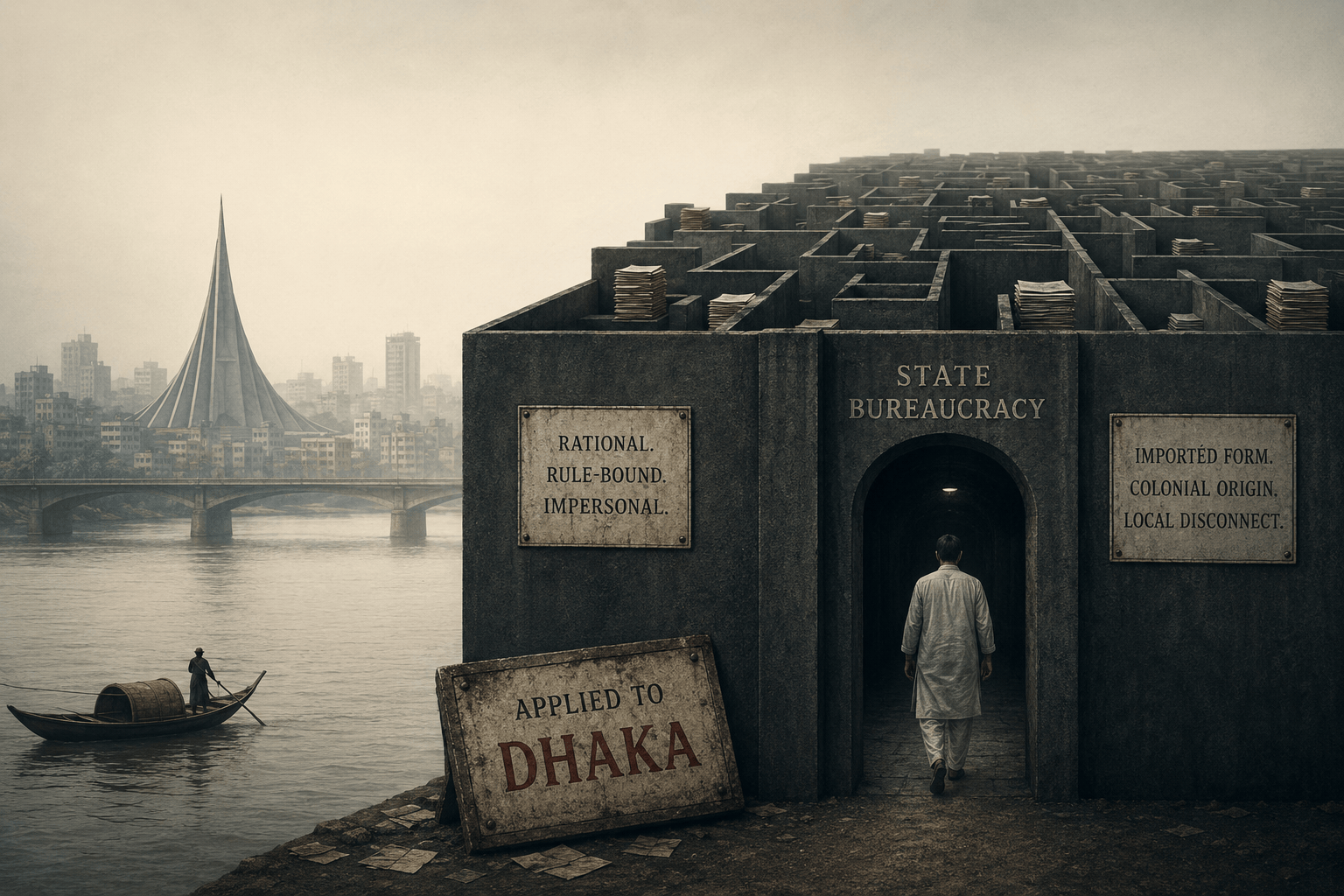





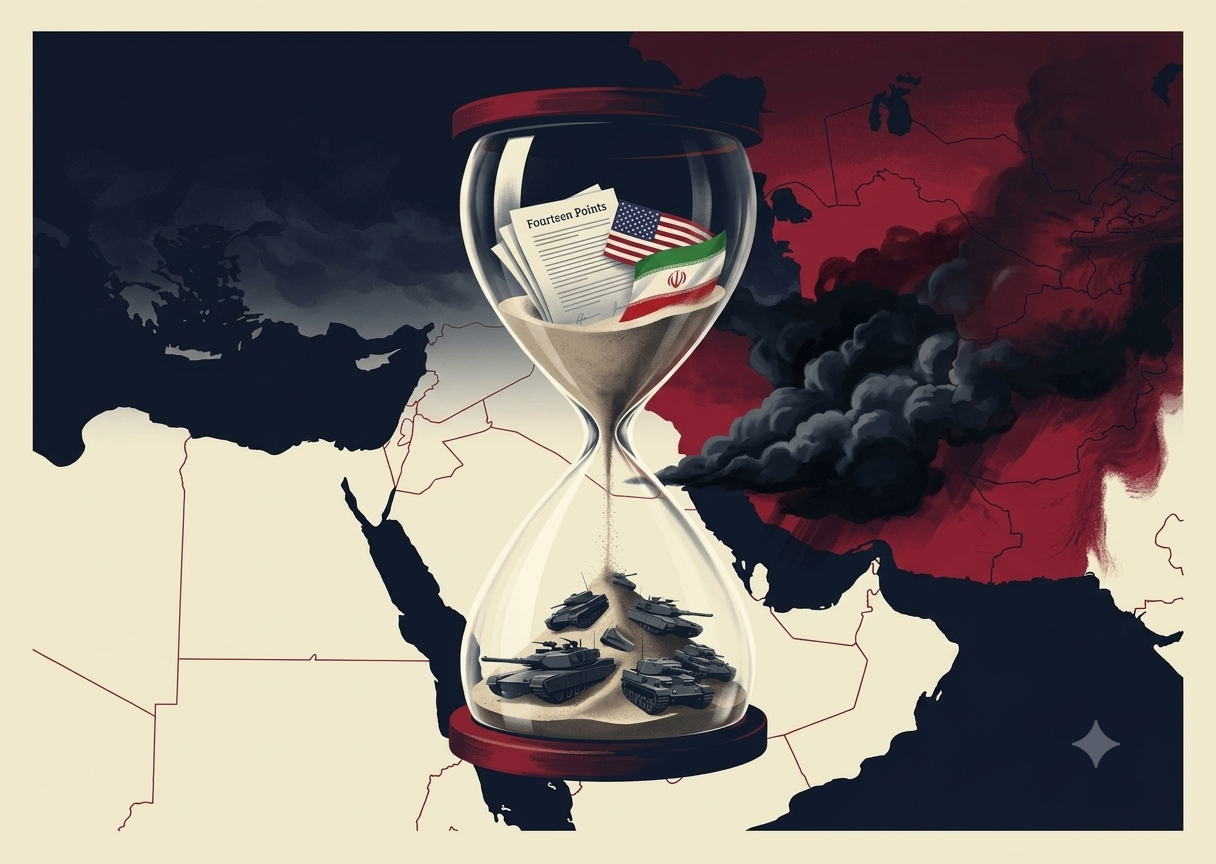




In the closing pages of The Grand Chessboard, Zbigniew Brzezinski observed that the great powers of Eurasia rarely announce their realignments — they reveal them through the sequencing of small courtesies: who is visited first, who is invited to witness which signing, and whose river gets whose engineers. By that measure, Prime Minister Tarique Rahman's maiden overseas tour — Kuala Lumpur on 21–22 June, then Dalian and Beijing from 22–26 June 2026 — is not a routine diplomatic itinerary. It is a document of intent, written in red-carpet motorcades and river-management memoranda, that every chancellery in the region is now reading with unusual care.
PART I — The Malaysian Opening: Labour, Trade, and a Signal to ASEAN
Tarique Rahman's choice of Malaysia as his first bilateral stop was not merely symbolic. It was strategically calibrated to carry multiple messages simultaneously — without triggering the media firestorm that an early Delhi visit would have produced. Malaysia offers Dhaka the rare combination of a Muslim-majority partner, a significant labour market, and a gateway into ASEAN, the regional architecture Bangladesh has long aspired to enter but never formally joined.
The summit with Prime Minister Anwar Ibrahim at the Perdana Putra Complex in Putrajaya produced a dense joint statement covering trade, investment, labour, defence, energy, and digital technology. At its centre sat a practical crisis: Malaysia's labour market for Bangladeshi migrant workers has been effectively suspended since June 2024, following years of abuse by politically connected recruitment syndicates that charged workers multiples of the official migration cost and left many stranded in debt bondage. Rahman raised the issue directly, calling for the market to reopen "as soon as possible" and insisting that any new arrangement be "transparent, fair, and affordable, reducing the role of intermediaries."
The two governments agreed to convene a Joint Working Group to review the existing MoU on recruitment and draft an updated framework that reflects current conditions. The structural problem — syndication, corruption, and inflated costs that have historically plagued the corridor — will test whether Dhaka and Kuala Lumpur can build a genuinely reformed system or merely issue fresh paperwork over old networks. The stakes are considerable: remittances constitute a lifeline for Bangladesh's foreign exchange position, and Malaysia, with approximately 800 Bangladeshis accepted between December 2025 and January 2026 under a more stringent screening process, holds the keys to one of the country's four largest overseas labour markets.
Malaysia: Agreements & Commitments, 22 June 2026
- MoU on Cultural Cooperation (signed in presence of both Prime Ministers)
- Exchange of Note on Counter-Terrorism Research and Capacity Building
- Exchange of Note on Investment Promotion and Facilitation
- Commitment to fast-track Malaysia–Bangladesh Free Trade Agreement (MBFTA) negotiations, with a 2027 target
- Joint Working Group on Labour: review existing MoU and draft updated framework on Bangladeshi worker recruitment
- Defence Cooperation MoU operationalisation; Joint Committee on Defence Cooperation (JCDC) to convene
- LNG Supply and Energy Infrastructure cooperation (PETRONAS–PetroBangla direct discussions encouraged)
- Semiconductor, AI, fintech, and digital governance partnership
- Malaysia supports Bangladesh's ASEAN Sectoral Dialogue Partner bid and UNGA 81st session presidency candidacy
Beyond the labour file, the two leaders committed to advancing negotiations on a bilateral free trade agreement by 2027 — a commercially significant target given that Bangladesh remains Malaysia's second-largest trading partner in South Asia. Rahman also met the chief executives of five major Malaysian conglomerates — Petronas, Axiata, AirAsia, Perodua, and MMC Group — pitching Bangladesh's workforce, its large domestic market, and the new government's pro-investment framework. The pursuit of ASEAN Sectoral Dialogue Partner status, backed by Malaysia's public endorsement, marks the clearest articulation yet of Dhaka's intent to anchor itself in the Indo-Pacific's existing institutional architecture rather than remain a passive observer of it.
While shared Muslim identity provided a soft launchpad for departing from the tradition of prioritising India, Rahman also avoided immediate controversy — much as Maldives President Muizzu had done — by delaying a China visit until after establishing regional groundwork.
PART II — Beijing: Thirteen MoUs, the Teesta Question, and a Corridor India Fears
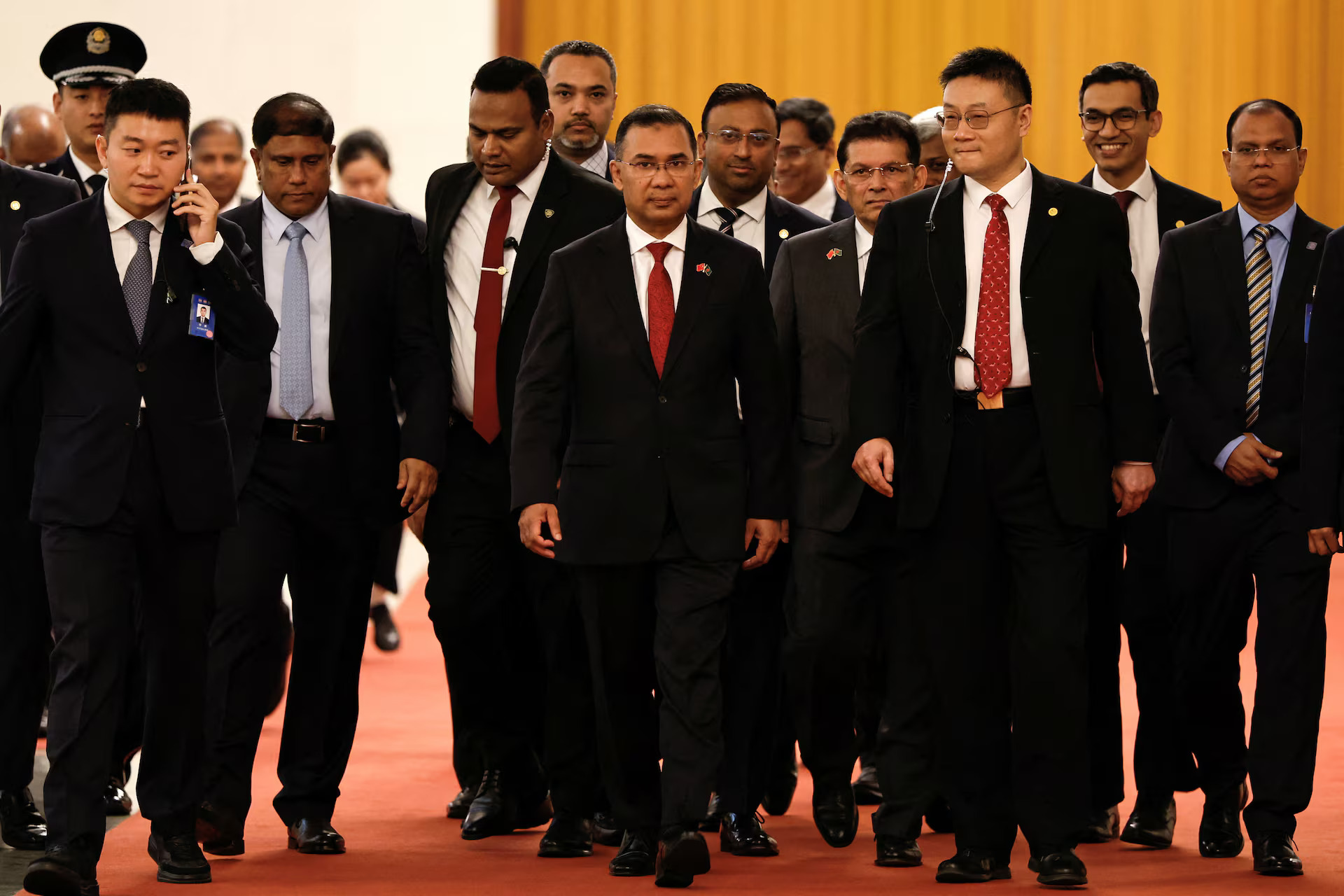
From Kuala Lumpur, Rahman flew directly to Dalian on 22 June, where he participated in the World Economic Forum's Annual Meeting of the New Champions — the Summer Davos — before travelling to Beijing by high-speed train on 24 June. The train journey itself carried an incidental symbolism: China's bullet-rail infrastructure, which Bangladesh is exploring for its own network, delivering the Bangladeshi prime minister to the capital in comfort while the country's own rail ambitions remain mired in feasibility studies. Beijing received him with a ceremonial motorcade, a red-carpet reception at Chaoyang Railway Station, and the hospitality of Diaoyutai State Guesthouse — signals reserved for visits of substantive strategic weight.
The core diplomatic output of the Beijing leg came on 25 June, when Rahman held bilateral talks with Premier Li Qiang at the Great Hall of the People. The two sides signed at least thirteen — and by some accounts fifteen — MoUs covering an expansive range of sectors. The character of this visit was notably different from previous Bangladeshi prime ministerial visits to China, which had typically centred on concessional loans and project financing under the Belt and Road Initiative. This time, the emphasis shifted toward investment, political alignment, and long-term strategic partnership.
China: MoUs & Agreements Signed, 25–26 June 2026
- Teesta River Comprehensive Management and Restoration Project: consensus on cooperation in the Master Plan, river dredging, flood-risk mitigation, erosion control, irrigation, and inland navigation
- Framework for Modernisation and Renovation of Mongla Port
- Bangladesh–China participation in the Global Development Initiative (GDI): healthcare, education, and human resource development
- BNP–Communist Party of China (CPC) party-to-party MoU
- Chinese Investment in Anwara (Chattogram) and Mongla Special Economic Zones
- Environmentally Friendly (Green) Energy Generation
- Geological Survey Cooperation
- Artificial Intelligence Development
- Technical and Vocational Education
- Mandarin Language Education: incorporation into Bangladesh's school curriculum
- Media Cooperation: Bangladesh–Xinhua News Agency MoU (signed in presence of both PMs)
- Human Resource Development (joint plan)
- Export of Bangladeshi jackfruit to China
- "2+2 Dialogue" mechanism: foreign affairs and defence ministries of both countries to hold regular consultations
- China–Myanmar–Bangladesh Economic Corridor: proposed by Xi Jinping during the Rahman–Xi summit
The Teesta item dominated headlines — and for good reason. Chinese Water Resources Minister Li Guoying called on Rahman at Diaoyutai on 25 June and assured Bangladesh of "full cooperation" on the Teesta Master Plan, offering technical assistance, research partnerships, and training for Bangladeshi water experts in China. The Teesta River Comprehensive Management and Restoration Project — a Chinese-backed initiative covering Bangladesh's agriculturally critical northern districts including Nilphamari, Kurigram, Lalmonirhat, Gaibandha, and Rangpur — had been effectively placed in cold storage during the final months of the Hasina government, when New Delhi successfully lobbied Dhaka to prefer an Indian technical alternative. That reversal is now itself reversed. The Rahman government has unambiguously returned China to the centre of the Teesta file, not merely as a financier but as the technical partner of record.
The visit's most geopolitically charged moment came on 26 June, when Rahman met President Xi Jinping at the Great Hall of the People. The two leaders jointly announced the decision to build a "China–Bangladesh Community with a Shared Future in the New Era" — the precise diplomatic formula Beijing has applied to its most strategically valued bilateral relationships. Xi committed China to high-quality Belt and Road cooperation with Dhaka, alignment of development strategies, and cooperation in green and low-carbon development, digital economy, information technology, and artificial intelligence. More consequentially, Xi proposed the revival and renaming of an old idea: a China–Myanmar–Bangladesh Economic Corridor, connecting China's Yunnan Province with Dhaka via Myanmar. A prior iteration of this — the Bangladesh–China–India–Myanmar (BCIM) Corridor — had been proposed in 2015 but abandoned in 2019 after India refused to participate. The new proposal drops India from the name entirely.
The new corridor proposal drops India from the name entirely — a diplomatic subtraction that carries more strategic weight than any addition in the document.
PART III : How Delhi Reads the Map
India's reaction to this tour has been a careful study in simultaneous alarm and accommodation. The timing of New Delhi's most visible goodwill gesture — the announcement on 25 June by the new Indian High Commissioner Dinesh Trivedi that India would resume tourist visas for Bangladeshi nationals from 28 June, ending a two-year suspension — was not accidental. Delhi chose the precise day of Rahman's bilateral talks with Li Qiang to demonstrate its own willingness to re-engage. The choreography was transparent: India signalling concession on the day Dhaka was deepening its embrace of Beijing.
The structural sources of Indian anxiety are compounded and real. The Teesta reactivation is not merely a water dispute — it places Chinese engineers, researchers, and eventually contractors in a river basin that feeds north Bangladesh and lies geographically proximate to what Indian strategic planners call the Siliguri Corridor, the approximately 22-kilometre-wide strip of Indian territory connecting the eight northeastern states to the rest of the country. Any Chinese infrastructure presence in northern Bangladesh — whether dam management systems, flood monitoring equipment, or river dredging facilities — compresses that strategic buffer. The China–Myanmar–Bangladesh Economic Corridor deepens this further: if realised, it creates a supply and logistics chain running from Yunnan through a Myanmar that is already effectively a Chinese client state, into Bangladeshi territory, bypassing Indian geography entirely. From New Delhi's perspective, this is not connectivity — it is encirclement by infrastructure.
The wider India–Bangladesh relationship has been in managed deterioration since the fall of Sheikh Hasina in August 2024. The Hasina era was India's "Golden Chapter" — a period of deep bilateral alignment in which Dhaka delivered on Indian security priorities (cracking down on northeast insurgent sanctuaries), accepted Indian connectivity projects, and kept Chinese strategic infrastructure ambitions at arm's length. That architecture collapsed with Hasina's ouster. The months of the Yunus interim government saw a tilt toward China and Pakistan — resumed direct flights, eased visa procedures, military exchanges — that alarmed New Delhi. The BNP's decisive electoral victory in February 2026, while offering India a more tractable interlocutor than a Jamaat-led government would have, has not restored the old equilibrium. The reservoir of mistrust runs in both directions.
Several specific irritants remain open wounds. Sheikh Hasina's continued presence in India, where she has been sheltering since August 2024 and where she was sentenced to death in absentia by Bangladesh's International Crimes Tribunal in November 2025 for the 2024 crackdowns, is the most politically charged. Dhaka has demanded extradition; New Delhi has not moved. A June 2026 incident in which Rahman's adviser Zahed Ur Rahman was held at Delhi airport for nearly two and a half hours before being allowed entry — resolved only after intervention from senior Indian officials — resulted in Bangladesh summoning the Indian Deputy High Commissioner. The Jamaat-e-Islami's geographic concentration along the border districts of West Bengal and Assam after its strong showing in the February elections adds a structural security dimension to New Delhi's political anxiety. The Ganga treaty expires in December 2026, opening a fresh water-sharing negotiation at exactly the moment when Chinese involvement in the Teesta has made Dhaka less dependent on Indian goodwill over river politics.
What India confronts is not a hostile Bangladesh so much as an independent one — and for a regional power that built its neighbourhood policy on the assumption of Dhaka's structural deference, the distinction is almost as uncomfortable. Rahman's government has been explicit: "balanced foreign policy" and "sovereignty-first" are its stated operating principles. His decision to visit Malaysia and China before India — breaking a decades-old diplomatic convention — was not an accident of scheduling. It was a choice to preserve political longevity and avoid controversies at home, given that many Bangladeshis still associate Indian proximity with the Hasina era. Modi had sent an invitation as early as February, through Lok Sabha Speaker Om Birla at Rahman's swearing-in. It has not yet been accepted. A Bangladesh PM has chosen China before India for the first time since 1975. That is not a footnote — it is the headline.
India confronts not a hostile Bangladesh so much as an independent one — and for a regional power built on Dhaka's structural deference, the distinction is almost as uncomfortable.
PAPYRUS VERDICT: A Rebalancing, Not a Rupture. But Delhi Has Less Time Than It Thinks
Tarique Rahman's maiden overseas tour should not be misread as a pro-China pivot in the ideological sense. Bangladesh's foreign policy under his government is genuinely multi-directional: the Malaysia visit pursued labour remittances and ASEAN integration; the Beijing visit pursued investment, water management, and infrastructure on commercially rational terms. The "sovereignty-first" framing is real, not merely rhetorical. Dhaka is not choosing between New Delhi and Beijing — it is refusing to make that choice, a refusal that itself represents a structural shift from the Hasina era.
But the consequences for India are not diluted by Dhaka's stated intentions. The Teesta reactivation places Chinese technical presence in a strategically sensitive river basin. The China–Myanmar–Bangladesh Economic Corridor, if it advances beyond proposal, will route Chinese commercial infrastructure through Bangladesh's north in a geography India has traditionally regarded as its backyard. The 2+2 foreign affairs and defence dialogue mechanism between Dhaka and Beijing marks a new level of strategic institutionalisation between the two countries. And Mandarin in Bangladesh's school curriculum is, over a generation, a soft-power investment whose returns will compound in ways a single trade agreement cannot offset.
India's tools for managing this are not absent and CEPA fast-tracked for the post-LDC graduation period, genuine movement on the Ganga treaty renewal, and above all a resolution of the Hasina extradition question could recalibrate Dhaka's calculus faster than any number of visa announcements. But New Delhi's track record of treating Bangladesh as a permanently available partner rather than a sovereign state with its own interests has produced the current situation. Rahman's tour was the first major course correction of the post-Hasina era. It will not be the last.
THE PAPYRUS | thepapyrus.com.bd
Comments