








There is a line attributed to Zhou Enlai, China's founding premier ,when asked about the impact of the French Revolution:
"It is too early to say." The story is almost certainly apocryphal. But as a description of how Beijing thinks about time, strategy, and the patience required to displace a rival superpower, it is more accurate than any official doctrine.
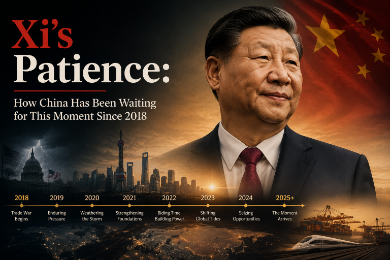
When Donald Trump returned to Beijing in May 2026, most Western commentary framed it as Trump's second act another bold, unpredictable move by an unconventional president. That framing is wrong. The correct frame is this: Xi Jinping has been waiting for this moment since July 6, 2018, the day the first American tariff on Chinese goods went into effect. Everything that happened between that date and Trump's arrival at Beijing Capital Airport eight years later was, from Beijing's perspective, a sequence of moves in a game whose end China always believed it would win.
This is the story of that game.
2018: The Provocation That Became a Gift
The conventional reading of 2018 is that Trump caught China off guard that the tariffs were a shock, a disruption, an economic assault that Beijing scrambled to absorb. The reality was more complicated, and more instructive.
China did scramble, initially. Growth slowed. Export orders fell. Supply chains shifted. Soybean farmers in the American Midwest felt the retaliatory tariffs within months. But Chinese leaders, watching the political economy of the United States more carefully than most Western analysts acknowledged, identified something that the tariffs also revealed: America's industrial base was not coming back quickly enough to substitute for Chinese manufacturing at scale. The tariffs raised costs for American consumers and companies without rebuilding the production capacity they were intended to restore.
Beijing drew a strategic conclusion from this: the United States could impose pain, but it could not rapidly escape its own dependency. The goal, therefore, was not to win the trade war in the short term — it was to outlast it.
China simultaneously pursued two tracks. Domestically, it accelerated the "Made in China 2025" initiative investing heavily in advanced manufacturing, semiconductors, electric vehicles and the industrial infrastructure that would reduce dependence on foreign technology. Internationally, it opened new overseas markets, deepening trade relationships across Southeast Asia, Africa, the Middle East and Latin America through the Belt and Road Initiative. By the time Trump returned to office in January 2025, China's trade surplus had grown, not shrunk. In 2025, it reached an extraordinary $1.2 trillion the largest in history. China's exports surged 21.8% year on year in the first two months of 2026, far outpacing all expectations.
Trump's tariff war, intended to weaken China, had inadvertently forced it to build the alternative architecture that would eventually make it less vulnerable to American pressure.
The Rare Earth Masterstroke
If the trade war was China's proving ground, rare earth minerals became its most precise strategic weapon.
The sequence is worth tracing carefully. In April 2025, China imposed export licensing requirements on seven heavy rare earth elements materials essential to defense systems, electric vehicles, wind turbines, and advanced electronics. The move was surgical. China controls roughly 90% of global rare earth processing, as well as dominant shares of tungsten (80%) and antimony (60%). The licensing requirements did not cut supply entirely that would have been too blunt, too easy to condemn globally. Instead, they created uncertainty. Licensing approval rates for European firms fell below 25%. Prices spiked sixfold in some categories. American defense contractors began emergency searches for alternative supply.
The timing was not accidental. The controls were escalated in October 2025 one day before Trump canceled his planned APEC meeting with Xi in South Korea. The message was unmistakable: there are costs for diplomatic discourtesy, and Beijing controls the valve.
Then, at the October 2025 Busan Summit, the meeting that preceded the May 2026 Beijing visit China suspended the newer round of controls for one year in exchange for American concessions. The April controls, and the underlying licensing architecture, remained fully intact. This is the key point: China demonstrated that it could escalate, de-escalate, and re-escalate at will, without dismantling the system that gave it leverage in the first place. As one analysis concluded, China was "weaponizing control, not scarcity" maintaining pricing power and extracting strategic concessions while preventing large-scale Western investment in alternatives.
By the time Trump landed in Beijing in May 2026, China's rare earth architecture had become a permanent structural feature of global trade, not a temporary negotiating instrument. The licensing system created institutional momentum bureaucracies with national security mandates expand, they do not retreat.
Reading the Chessboard: What Xi Saw That Others Didn't
To understand Xi's patience, you need to understand what he was watching while the West focused on tariff percentages and trade deficit figures.
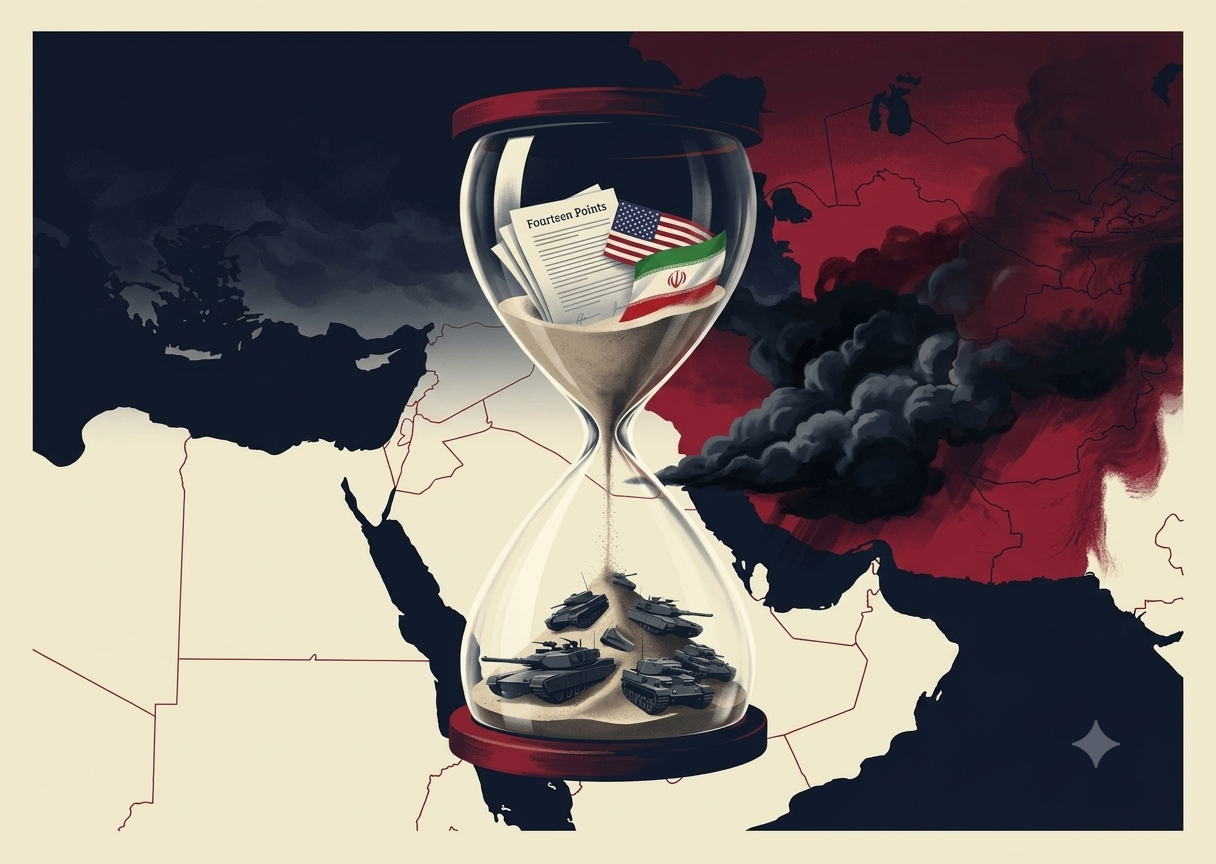
He was watching American politics fracture. The Iran war which began in early 2026 and which the White House projected would last four to six weeks had stretched into months, consuming military logistics, diplomatic bandwidth, and domestic political capital simultaneously. Trump's approval ratings were at record lows. The Strait of Hormuz was functionally paralyzed, spiking fuel prices globally. The United States had diverted military assets away from the Pacific from South Korea and Japan to the Middle East. That redeployment reduced America's credible deterrence in precisely the theater where China's interests are most acute: Taiwan.
Xi saw an America distracted, weakened, and in need of a diplomatic win. He also saw something the tariff hawks in Washington consistently underestimated: China's ability to absorb pain was structurally greater than America's, because Xi does not face elections, and the Chinese Communist Party's legitimacy rests not on quarterly approval ratings but on long-term delivery of national strength.
Trump needed the Beijing summit more than Xi did. That asymmetry a distracted superpower seeking relief, a patient one setting terms defined every outcome that followed.
The Broader Architecture: Building While America Reacted
Zoom out from the bilateral to the global, and the pattern becomes even clearer.
While the United States spent the 2018-2026 period oscillating between tariff escalation and managed truces, China was building. The Belt and Road Initiative deepened China's economic presence across more than 140 countries. Trade surpluses funded sovereign wealth instruments, port acquisitions, and infrastructure that created structural dependency in Global South economies. Beijing positioned itself as the champion of free trade — criticizing American protectionism at the WTO, at ASEAN summits, at G20 sessions precisely at the moment when US credibility as a rules-based trading partner was most in question.
The results are not abstract. China's trade surplus of $1.2 trillion in 2025 is not simply a number it represents the net transfer of economic surplus from the rest of the world into Chinese industrial capacity, year after year. It funds the semiconductor fabs, the AI research programs, the naval shipbuilding program that now produces more tonnage annually than the entire rest of the world combined.
Rush Doshi, in his landmark study of Chinese grand strategy, identified three phases of China's displacement of American order: blunting, building, and expanding. The 2018-2026 period is, in retrospect, the transition from building to expanding. China no longer merely seeks to limit American reach it is actively constructing an alternative order, one in which Beijing sets the terms, controls the chokepoints, and invites others to participate on its conditions.
What This Means for the Beijing Summit and After
The May 2026 summit must be read against this backdrop. When Trump called it "incredible" and declared "fantastic trade deals," Xi said something different: he "touted a new era for the stability of China-U.S. relations." Those are not the same statement. One is transactional. The other is structural.
Xi's framing is the more significant one. A stable China-U.S. relationship on terms Beijing has shaped is precisely what China's long game required. Not confrontation, which accelerates Western coalition-building against China. Not capitulation, which would signal weakness internally and externally. Managed stability, in which China continues to expand its structural position while the diplomatic surface remains calm enough to prevent the kind of unified Western response that could actually constrain it.
The rare earth controls remain. The trade surplus continues. The Belt and Road deepens. The Pacific military balance shifts incrementally but persistently in China's favor. And the US, preoccupied with Iran, faces the 2026 midterms with a president who needed a headline from Beijing — and got one.
Eight years ago, on July 6, 2018, the first American tariff on Chinese goods took effect. The trade war was supposed to bring China to its knees. Instead, it forced China to build the muscles it needed to sit across the table from America in Beijing, on Xi's terms and offer a managed pause that changes nothing structural, while appearing to change everything.
That is what patience looks like when it is exercised with strategic discipline over a decade. And that is why, when the history of this era is written, the Beijing summit of May 2026 will be remembered not as Trump's triumph, but as the moment the long game came into full view.

Comments