





A Kremlin ideologue's case that Russia is still fighting Operation Barbarossa and what the battlefield says he leaves out
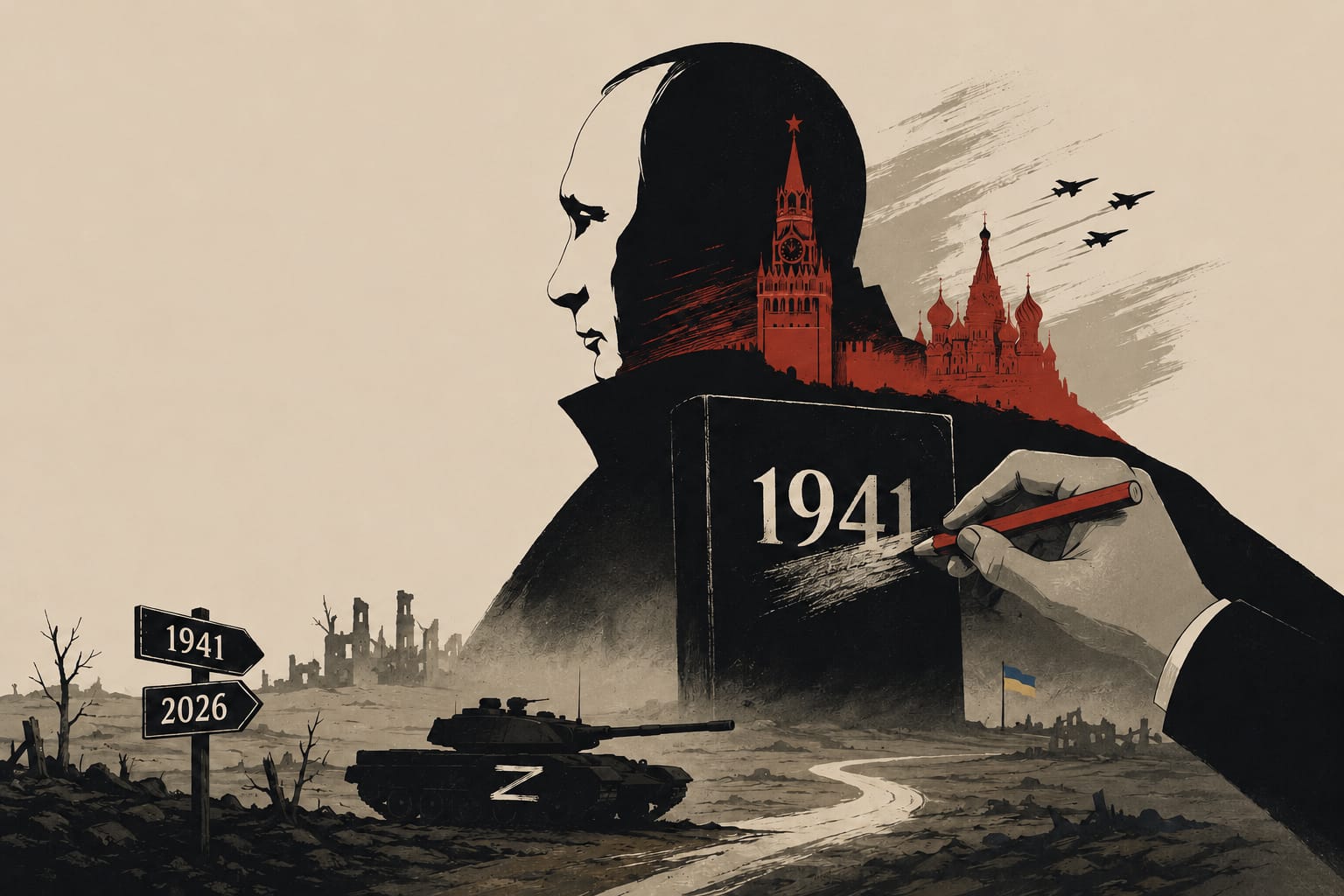
George Orwell built his fictional superstate on a single mechanical principle: whoever holds the present can rewrite the past, and whoever owns the past commands the future. Nineteen Eighty-Four was published as a warning, not a blueprint. But on June 22, 2026 — the eighty-fifth anniversary of Hitler's invasion of the Soviet Union — Alexander Dugin, the philosopher most closely associated with the ideology Moscow now markets as Russia's "state-civilization," appeared on Sputnik television to do precisely what Orwell described: fold the present so completely into a story about the past that resisting the story becomes indistinguishable from resisting reality itself.
Dugin's argument, stripped of its broadcast theatrics, runs in three movements. The first is that Operation Barbarossa was never simply Hitler's war of annihilation against Bolshevism, but the fruit of patient British intelligence work — operatives who, in his telling, spent years convincing Hitler that the "national" half of National Socialism mattered more than the "socialist" half, steering Germany's fury toward Moscow and away from London. Stalin's catastrophic trust in the 1939 non-aggression pact with Berlin was not naivety so much as a reasonable bet on a coin that had already been weighted elsewhere; the real author of June 22, in this account, sat in Whitehall rather than Berlin.
The second movement concedes that the victory of 1945 was real but treats it as incomplete. The decision to halt at the Elbe rather than push to the Atlantic, Dugin argues, buried a mine under Russia's future that detonated forty-four years later, when the Soviet leadership of the late 1980s committed what he frames as an act of civilizational suicide — surrendering not just territory and ideology but the right to author Russia's own history. The post-Soviet technocrats who negotiated that surrender, in his account, never really left government. They changed their vocabulary while keeping their children in Western schools and their savings in Western banks.
The third movement is where the rhetoric stops being a history lecture and starts doing political work. June 22, 1941, Dugin insists, never actually ended — it is "the past that refuses to pass," a recurring structure rather than a closed event, and Russia is living through it again, with Ukraine cast as the vanguard of a Western project to finish what Hitler started. NATO and the European Union occupy, in this framing, the same structural position Hitler's occupied Europe held in 1941: a continental bloc assembled, willingly or not, into an instrument pointed at Moscow. The conclusion follows almost mechanically. A war that is in fact a continuation of 1941 cannot be settled the way one settles a border dispute. It can only be won, this time all the way to the Channel, or lost again — perhaps for good.
The trouble with the first movement is that it requires erasing what historians have established about Hitler's own stated intentions across two decades, not two years, before 1941. Hitler wrote in the mid-1920s that German Lebensraum would be found in the East, at Russia's expense; that was not a conclusion British agents nudged him toward in the late 1930s, it was the organizing idea of his entire political project, restated publicly and privately for fifteen years before a single Wehrmacht division crossed the Bug River. The 1939 pact with Moscow was, on the German side, a tactical pause that let Hitler fight a two-front war sequentially — Poland and France first, the Soviet Union after — not evidence that Berlin's natural enemy was London all along.
There is a genuine and uncomfortable historical debate about how far Western appeasement at Munich, and the slowness of Anglo-French guarantees, fed Hitler's confidence that he could move east without serious interference. That is a defensible, if contested, line of argument. It is a wide gulf from there to Dugin's claim of a deliberate, organized British production of June 22 — a claim that belongs less to historiography than to the genre in which any catastrophe befalling Russia must trace back to a hidden Anglo-Saxon hand rather than to decisions made in Moscow or Berlin. The same move recurs in the third movement: treating NATO enlargement, European integration, and Ukrainian sovereignty as a single continuous Western project against Russia, rather than as policies adopted by dozens of separate and often disagreeing governments responding to Russian actions including the 2014 annexation of Crimea, strips the other side of agency entirely. Once agency is gone, so is the possibility that anything the other side does — sanctions relief, security guarantees, territorial compromise — could ever actually end the conflict, because in this telling the conflict was never really about Ukraine to begin with.
That distinction is not academic. It explains something genuinely useful about Kremlin behavior in the fifth year of the war. If June 22 is a recurring structure rather than a finished event, a ceasefire along the current line of contact is not peace — it is the same kind of pause the 1939 pact represented before Barbarossa, a breath before the next round. That logic tracks closely with what negotiators have actually experienced across more than a year of trilateral talks: positions that harden between sessions, a Russian delegation known for unbending rhetoric, and a Kremlin that in June 2026 offered to resume negotiations "on the basis of the Istanbul agreements" struck in the war's first weeks back in 2022 — effectively asking Kyiv to accept terms drafted before either side had absorbed the bulk of four years of casualties.
It also explains Dugin's otherwise odd insistence, deep in the interview, that Russia's own elite remains insufficiently purged of Western sympathy. If the war is civilizational rather than territorial, officials who privately want a deal that lets sanctions lift and capital move again are not being pragmatic; they are collaborators in the same sense as the reformers he blames for losing the Soviet Union. That argument, made on state-aligned television, runs directly against the kind of negotiated, face-saving compromise most outside observers believe is the only realistic way this war ends — which is worth knowing before reading too much into any single Kremlin peace overture.
Set against this mythology, the material facts of the war look considerably less like 1941 and considerably more like a grinding war of attrition that neither side is currently winning outright. After more than four years of fighting, Russian forces hold roughly a fifth of Ukraine's internationally recognized territory, including Crimea and the Donbas areas seized before 2022 — a line that has barely moved in two years despite Moscow's continuous offensive posture. Western analysts tracking the front have clocked Russian advances slowing to a crawl, creeping forward at roughly seventy meters a day along the Pokrovsk axis through 2025 and into 2026, a pace slower than Allied troops managed during the notoriously bloody Battle of the Somme. By the spring of 2026 that slow advance had gone into reverse, with Russia recording net territorial losses in several consecutive months even as Ukrainian long-range drones reached targets more than a thousand miles inside Russia, striking the Urals region Russians have considered safe from invasion since Napoleon's time.
The human cost dwarfs anything in the post-1945 European order. Britain's top intelligence officials estimated in May 2026 that close to half a million Russian soldiers had been killed since the invasion began, with total Russian casualties — killed, wounded, and missing — assessed by multiple Western governments and research institutions at well over a million. Ukrainian losses, while smaller, are also enormous, estimated in the hundreds of thousands. Both figures exceed, by a wide margin, anything either nation has absorbed in a single conflict since the war Dugin invokes.
None of this has produced a settlement. Trilateral talks among the United States, Ukraine, and Russia ran through most of 2026 — Abu Dhabi, then Geneva — and produced prisoner exchanges but no agreement on the two questions that actually decide the war: where the new border sits, and what security guarantees, if any, would stop Russia from trying again. Polling on both sides tells a similar story of populations further along in their appetite for compromise than either government appears willing to admit publicly. Solid majorities of both Russians and Ukrainians tell pollsters they would accept negotiated terms, even as Moscow's negotiators and Kyiv's leadership continue to stake out maximalist positions in public.
The Papyrus Verdict
Dugin's broadcast is not really about 1941. It is wartime political technology, built for an audience that has paid an extraordinary price for a war whose territorial returns have nearly stopped, and that needs a reason larger than a few hundred square kilometers of contested farmland to keep paying it. Casting June 22, 2026 as a continuation of June 22, 1941 accomplishes two things no battlefield report could: it turns four years of slowing gains and staggering losses into installments of a civilizational drama rather than evidence of strategic failure, and it turns any negotiated compromise into the same betrayal Dugin accuses Gorbachev's generation of committing — rather than what it would actually be: the ordinary, unglamorous way most wars this exhausting eventually end. Orwell's warning was that whoever controls memory controls the present. Dugin's broadcast is the live demonstration. A war stalled on the ground is being kept alive in the past tense, because in the past tense, Russia has never actually lost.
Comments